Five Things to Photograph at Every Inbound (and Why)

Most warehouse photo problems aren't problems of effort. The receiver showed up. The truck arrived. Pallets came off. Photos got taken — sometimes.
The problem is that the wrong photos got taken, in the wrong moments, and the right ones — the ones that would have settled a dispute three months later — never existed in the first place.
This article is a checklist. Five photographs to capture on every inbound, with one note for each on what kind of dispute that photo defends you against. It runs maybe 30 extra seconds on a typical receive. The payoff lasts years.
(Outbound shippers — we covered the parallel checklist in Whose Fault Is It? The Missing Pallet Problem. This piece is for the receiving side.)
1. The trailer doors — before they're opened
Take this picture as soon as the truck is backed in, before anyone touches the seal.
What to capture:
- The trailer doors closed.
- The seal, with the seal number visible.
- The DOT/MC plate on the trailer.
What it defends against: Strategic cargo theft. Specifically, the "fictitious pickup" and "Trojan driver" patterns that the FBI's IC3 PSA260430 (April 30, 2026) calls out as the fastest-growing fraud surface in trucking. If the seal doesn't match the BOL — or, worse, if there isn't one at all — that's evidence you'll need later.
Verisk's CargoNet 2025 trends report confirms strategic theft is now roughly a third of all cargo theft incidents. A photo of the seal at the moment of arrival is the cheapest defense your operation has.
2. BOL, driver license, and truck plate — together, in frame
As the driver hands over the BOL, photograph it next to their license and the truck's plate.
It feels invasive. It's not. It's the same documentation a notary would capture for any high-value transaction. Most legitimate carriers expect it now.
What to capture:
- The Bill of Lading, top sheet readable.
- The driver's commercial license (or a separate photo of it).
- The truck's plate or DOT/MC number.
What it defends against: Fictitious pickup — where someone shows up posing as a driver from a legitimate carrier, takes the load, and disappears. The FBI's April 2026 PSA explicitly recommends operations "document all parties comprehensively (driver photos, vehicle details, DOT numbers, contact records)." That's the standard now. If the load is later flagged as stolen, the photos let you (and law enforcement) trace the actual pickup back to a real person and a real vehicle.
For inbound, the same photo also forms the chain-of-custody anchor for any concealed-damage dispute. You know exactly which carrier delivered what.
3. Pallet condition — pre-unload, on the trailer floor
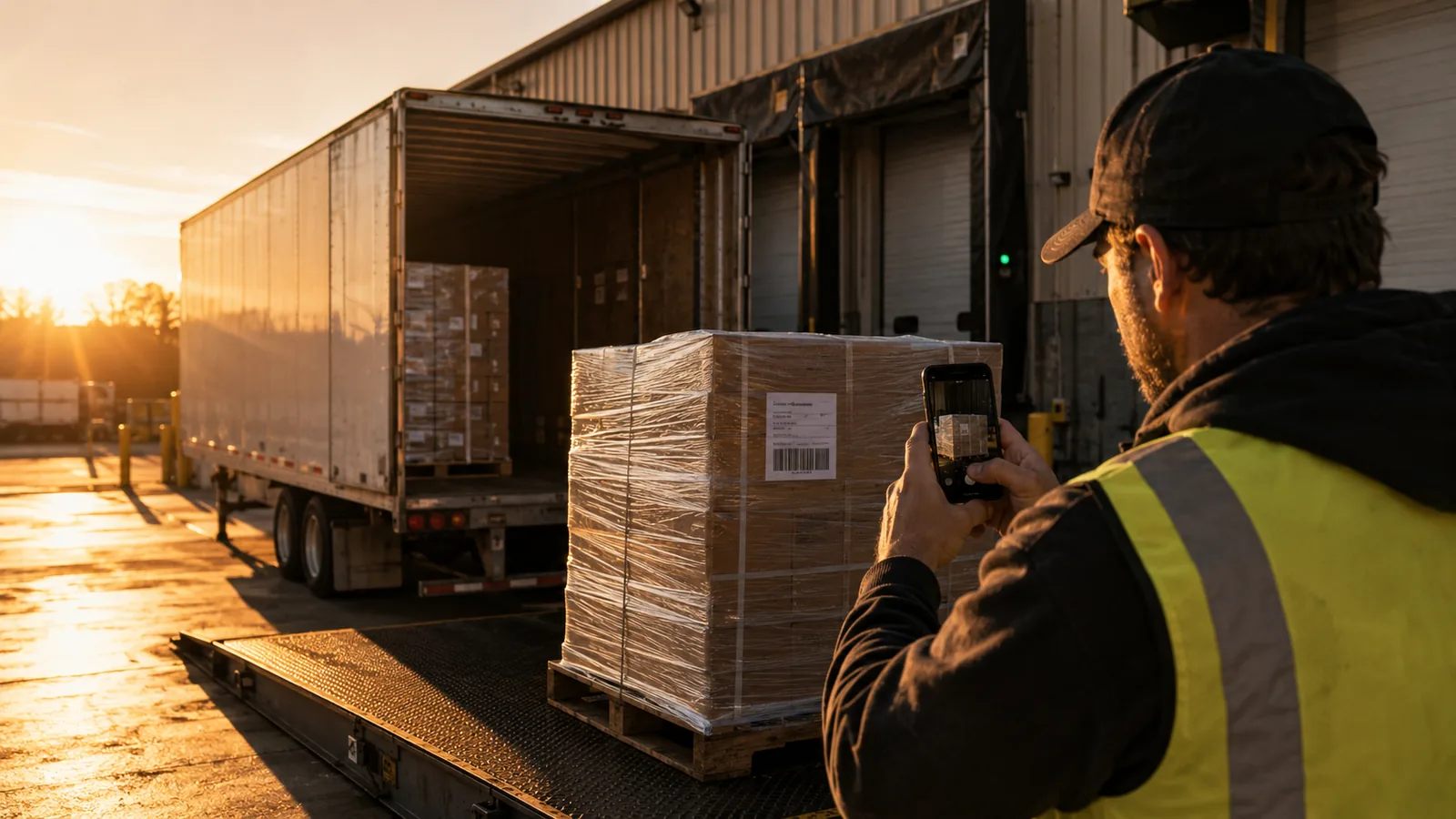
Photograph each pallet on the trailer before it comes off.
What to capture:
- Wrap condition (intact, torn, sagging).
- Visible damage (crushed corners, water marks, leaking).
- Carton-level damage if any is visible from the door.
- Pallet labels, in frame and legible.
What it defends against: Concealed damage claims. The brutal stat from CSA Transportation: more than half of freight claims are denied for "lack of proof or improper notation at delivery." Concealed-damage claims fare even worse — when carriers do accept them, they typically pay only one-third of standard liability.
The single thing that flips that math is contemporaneous photo evidence taken before the goods left the trailer. A photo of a crushed corner with the trailer floor in the frame is unambiguous: this was on the carrier when they handed it over.
4. Counts and shortages — with the BOL in the frame
If your count doesn't match the BOL, photograph the discrepancy with the BOL physically next to or on top of the goods.
What to capture:
- The pallets or cartons that arrived.
- The BOL showing the original count.
- A visible count gap — e.g., 8 pallets staged, BOL says 10, both in one shot.
What it defends against: OS&D (overage, shortage, damage) disputes — and, if you ship to retailers, downstream chargeback exposure. Walmart's OTIF program assesses up to 3% of COGS for late or short POs, and Target's Perfect Order Program (May 2025) layered new ASN/barcode penalties on top.
The thing the documentation lets you do is dispute. SupplierWiki reports that brands with systematic documentation dispute 40–60% of chargebacks; brands without dispute fewer than 10%. Same chargeback. Different recovery rate. The difference is the photo.
5. The trailer or load departing — wrapped, sealed, with the BOL
For pure receiving operations, this one's optional. For receivers that also ship outbound, it's mandatory.
What to capture:
- The wrapped, fully loaded trailer before the doors close.
- The BOL signed by the driver.
- The seal in place, seal number visible.
What it defends against: Outbound damage allocation. Once that trailer pulls away, the question becomes: did the damage happen on your dock or en route? A photo of the trailer in clean condition at departure puts the answer beyond reasonable argument. If the customer reports damage, you can show the trailer left intact. The dispute moves to the carrier — which is where it belongs.
This is the "Proof of Load" play we wrote up in detail here.
A quick checklist you can post on the wall
For every inbound:
- Trailer doors closed, with seal in frame.
- BOL + driver license + truck plate, together if possible.
- Pallet condition on the trailer floor, before unload.
- Counts and shortages with BOL in the frame.
- Trailer departure (if you ship out), wrapped and sealed.
Why DockSnap exists
Five photos. Thirty extra seconds per inbound. The hard part has never been taking the picture — it's been making sure the picture survives long enough to be useful.
DockSnap is the destination for those photos. Each one gets tagged automatically (barcode, OCR, or manual reference — see Barcode, OCR, or Just Type It), uploads to a central library, and stays searchable for as long as you keep the account open.
The operator on the dock doesn't have to think about filing, sharing, or sending. They take the five shots, tag the shipment, and move on. The next time a dispute lands, the evidence is already there.
Get started — most warehouses are running their first inbound through it within an hour.